


It starts with one document.
A contract pulled from a drawer. A court order issued years ago. A patent filing that suddenly needs to be enforced abroad. Once that document leaves its original jurisdiction, language stops being secondary. It becomes a legal variable.
Courts and regulatory agencies do not interpret translations. They do not guess intent. They read what is in front of them. That is why certified translation services for legal documents must reproduce the original text exactly as it appears. Same meaning. Same structure. Same legal weight.
A certified legal translation is not supporting material. It is evidence. Judges rely on it. Immigration officers rely on it. Attorneys build arguments around it. Every word, number, seal, and signature must be accounted for.
When accuracy fails, filings slow. When accuracy holds, cases move.

The Critical Importance of Accuracy in Legal Translation
Every legal clause serves a purpose. Modifying it slightly expands responsibility. A single mistranslated phrase can alter liability. A missing reference can undermine an entire claim. Courts do not reinterpret translated documents. They treat them as authoritative.
This is why court-admissible documentation depends on strict legal terminology precision. Formatting matters. Sentence order matters. Defined terms must remain consistent throughout the document. Even punctuation can affect meaning.
In sworn translation for litigation, accuracy is not implied. It is certified. The translator signs a statement confirming the translation is complete and faithful to the original. That confirmation carries legal responsibility.
Our Compliance Checklist: ISO 17100 and HIPAA Data Security
Legal translation follows strict rules for one reason: risk
When documents affect court outcomes or compliance, there is no room for guesswork. Well-structured processes are made to keep mistakes at bay.
ISO 17100 quality standards define how professional translations are produced. Not loosely. Precisely. They require qualified translators and a mandatory review by another linguistic professional. A subject matter expertise specific to the document type is another key requirement.
This structure forces accuracy. It eliminates shortcuts. It ensures that critical records—such as court filings and contractual agreements—are translated exactly as written, with nothing added and nothing lost.
Quality is only one side of the equation. Security is the other.
Legal documents often contain sensitive information. Medical details. Financial data. Corporate records. Every file we handle is protected by confidentiality agreements from the moment we first receive it. HIPAA-compliant protocols add another layer of protection. Encrypted data. Limited access. Files are managed securely from upload through final delivery.
Nothing is exposed. Nothing is left to chance.
Organizations that utilize certified translation services anticipate precision, but they also seek assurance.
Types of Legal Documents We Translate: Contracts, Patents, and Affidavits

Legal translation is not limited to one format.
Contracts must preserve clause structure to remain enforceable across jurisdictions. Patent filings combine technical language with legal standards, which is why professional patent translation services for law firms require specialists familiar with intellectual property law.
Affidavits and declarations require accurate copies of statements taken under oath. Courts frequently compare versions side by side with originals, line by line. Formatting, spacing, and notes are all vital.
Immigration applicants frequently require certified translation for USCIS legal documents 2026, where formatting and certification language are strictly reviewed. Many also require document translation for immigration filings submitted to embassies and international courts.
Each document carries different risks, but the standard remains the same for all documents.
Certified vs. Sworn Translation: Which One Does Your Case Require?
The difference matters.
Certified translations come with a signed statement, ensuring the translator is competent and that the translation is accurate and complete. U.S. courts, USCIS, and regulatory agencies all require this format. Many clients begin with certified translation services to ensure broad acceptance.
A sworn translation is completed by a translator authorized or registered with a court or government authority in certain countries. It is often required for litigation abroad or cross-border proceedings.
Submitting the wrong format can result in rejection, even when the translation itself is correct.
Ensuring Admissibility: How We Meet Global Court Requirements
Courts follow rules. Translations also must follow those rules. Legal document translations should mirror the original. Everything from page layout and stamps and seals to handwritten notes and Illegible elements must reflect in the translation as well.
Certification language appears as a separate statement identifying the translator, confirming language competence, and affirming accuracy. Some cases require a notarized affidavit of accuracy to accompany the translation.
These steps are not optional. They are how legal translations are accepted.
Data Privacy & Security: Our “Zero Storage” Policy for Sensitive Files

Sensitive legal documents shouldn’t remain accessible longer than necessary.
Our “zero storage” system deletes sensitive files right after they’ve been safely delivered. This method helps protect clients’ data thanks to encrypted portals with limited access, guaranteeing absolute privacy of secret legal translations for lawsuits.
And to make it clear, security is not an add-on for The Language Doctors. It is a professional responsibility.
Subject Matter Experts: Why Only Legal Professionals Handle Your Files
Legal translation is not general translation.
Every file is handled by professionals with legal training or direct legal experience. They understand procedural language, statutory references, and jurisdiction-specific terminology. That experience matters.
It cuts down on errors and keeps terminology consistent from the first page to the last. When a case gets complicated, translators don’t work in isolation. Editors and reviewers step in. Not because it looks good on paper, but because pressure is when mistakes usually happen. Extra eyes prevent that.
Rapid Turnaround Times for Urgent Litigation and Filing Deadlines
Deadlines aren’t flexible.
Court dates are fixed. Filing windows close. When documents are needed fast, speed cannot replace accuracy. Thanks to well-structured workflows, our projects move flawlessly without cutting corners.
No matter how short the time is, we always provide accurate certification and a second linguistic review after the first translation. Delivering a translation faster does not change how a court looks at a document.
Transparent Pricing: Cost-Effective Solutions for High-Volume Legal Projects
Clarity saves time and builds trust.
Legal document translation cost per word 2026 is one of the first questions of clients because they need real, fixed numbers and no surprise fees. However, rates are formed based on the language pair and the document complexity.
Turnaround time also plays a role in the pricing, but all rates are transparent from the start, before we start working.
Obviously, high-volume legal projects benefit from consistency, just like in any other industry.
They are provided with stable pricing and dedicated teams who make it easier to organize complex tasks and long-term projects. It’s especially useful for firms that deal with ongoing litigation.
Baseline: Clear pricing helps with planning. And planning reduces stress.
How to Order: Your Secure Step-by-Step Portal Walkthrough
There is a simple process. Documents are uploaded through a secure portal. Requirements are reviewed. We provide a quote. Once approved, we start translating. The final files are delivered with certification, ready for submission.
Many clients begin with certified translation services and later expand into legal translation services or legal interpreting services as their needs grow. The process stays the same. Only the scope changes.
FAQ
What makes a legal translation “certified”?
A certification. A certified translation comes with a signed document that confirms the translation is accurate and produced by a human, certified professional. This includes certificate translation services for all types of personal documents needed for official submission.
Do you offer translations for USCIS or international immigration courts?
Immigration cases always require certified translation for USCIS, with strict certification guidelines and formatting, and we cover all of these services.
How do you protect the confidentiality of sensitive legal documents?
Our zero-storage encrypted system deletes all sensitive files right after their safe delivery.
Can you provide notarized translations for legal filings?
Yes. A notarized affidavit of accuracy can be included when a filing authority requests it.
Are your translators trained in specific legal fields?
Yes. We assign translators based on their expertise in a specific field.
What is the typical turnaround time for a complex contract?
It really depends on length and complexity. Expedited options are available for emergencies.
Do you use AI or machine translation for legal documents?
Legal documents are translated by human, certified professionals.
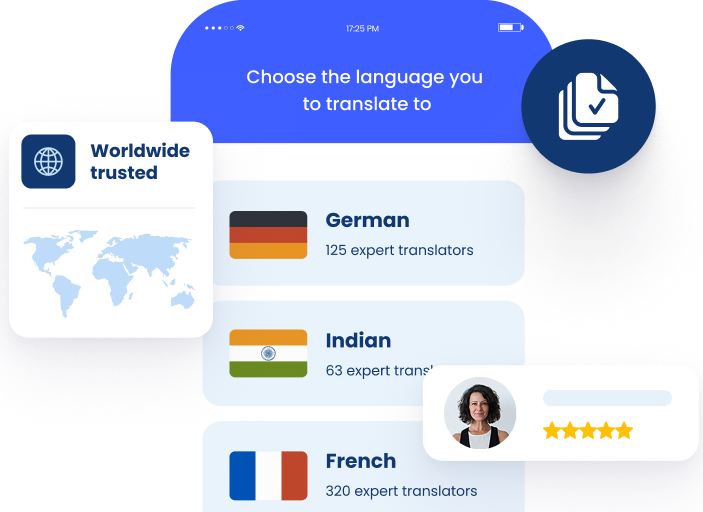
At The Language Doctors, we specialize in USCIS-certified translations that are trusted and accepted by immigration attorneys, government agencies, and embassies worldwide.
With our service, you can expect fast 24–48 hour turnaround times, certified translations in over 200 languages, and PDF delivery complete with a signed Certificate of Accuracy.
Everything you need to meet USCIS requirements with confidence. We offer affordable flat-rate pricing, so you always know what to expect with no hidden fees.
Get your USCIS translation today. Accurate, certified, and hassle-free.