
Education / Diploma Translations for US University Admissions
Diploma Translations for US University Admissions


If you are applying to a US university with a foreign diploma, translation is not optional. Most schools require a diploma translation for US university admissions that is accurate, complete, and certified. Mistakes slow decisions. Missing certification can stall applications. Professional academic translators help you meet admission rules, avoid delays, and present your credentials clearly from day one.
Applying to a US university is stressful enough. Lots of deadlines, forms, fees, transcripts, diplomas.
When your academic documents are not in English, translation becomes part of the admissions process. Not later. Right now.
A diploma translation for US university admissions is more than a language task. It is an admissions requirement. Many applicants learn this too late.
Universities do not evaluate documents in other languages. They evaluate English versions. That is simply how the process works.
Done correctly, translation moves your application forward. Done poorly, it creates questions. Sometimes rejections.

Why US Universities Require Certified Diploma Translations
Admissions officers are not linguists. They cannot guess what a foreign diploma says.
They need clarity and consistency. They also require legal assurance that the English translation accurately reflects the original document.
That is why many schools require certified diploma translations to USA standards. Certification tells the university one thing: this translation can be trusted.
Without certification, admissions teams cannot verify the degree type, the completion date, nor the academic level or the institution name. Even small ambiguities matter. Especially when thousands of applications are under review.
This is where professional university admission document translation becomes essential.
When a Diploma Translation Must Be Certified for Admissions
Not every school publishes the same rule. But most follow similar expectations. A diploma translation must be certified when the diploma is issued outside the US and when the original is not in English. This includes undergraduate and graduate programs.
Many applicants ask, do US universities require certified diploma translation?
In practice, yes. Most do. And those that do not explicitly require it often still expect it.
Certification protects you. It removes doubt before it starts.
Types of Diplomas Commonly Requested by US Universities

Depending on the level of education, admission offices can request different diplomas. Common requested diplomas may include:
- High school diplomas for undergraduates
- Secondary school certificates for international systems
- Bachelor’s diplomas for graduate programs
- Master’s diplomas for doctoral programs
A high school diploma translation for US universities is one of the most frequent requests. It must reflect the exact title and issuing authority, and most of all, the completion status.
For international applicants, foreign diploma translation USA requirements are strict. Schools want a word-for-word translation. No summaries, and certainly no added explanations.
Accuracy matters more than style.
Additional Academic Documents That Often Require Translation
Your diploma is rarely the only document needed. Universities often require academic transcripts, grade reports, certificates of graduation and enrollment confirmations. These are all college application translations required in the USA.
All academic records must align. Names and dates must match and formatting must be consistent. Professional academic diploma translation services handle these sets together, not as isolated files. This avoids contradictions that raise red flags.
Certified Translation Standards Accepted by US Colleges
Informal certification is a big NO for university admissions. When hiring professional linguistic services, have in mind that the certified translation must be complete, including a signed statement that shows the translator’s (agency’s) competency and the translation’s accuracy.
This is what qualifies as certified academic translation for admissions.
Notarization is a different matter and often misunderstood. Most universities do not require notarized translations.They require certified ones.
Understanding diploma translation requirements for US colleges prevents wasted time and resubmissions.
Professional agencies offering certified translation services follow these standards as routine practice, not as an extra step.
Common Diploma Translation Mistakes That Lead to Admission Delays

Most admission delays are preventable. There are many avoidable mistakes that take no time and are easly fixed, but only if you do it on time. For example, leaving seals untransalted or translate only one part of the diploma is a huge issue. Also, make sure all names spellings are consistent and certification statements are in place.
These mistakes force admissions teams to request clarification. Sometimes multiple times.
The result is delay. Missed deadlines. Deferred decisions.
Applicants often confuse USCIS vs university diploma translation rules. Yes, they are similar, but they’re far from identical. Immigration standards focus on legal compliance. Universities focus on academic accuracy. For USCIS interpreting services you should always hire a specialized linguistic agency.
A professional translator understands both and adjusts accordingly.
How Professional Diploma Translation Improves Admission Success
Translation is not about English fluency alone. It is about structure. Terminology. Academic equivalence.
Professional services specializing in how to translate diploma for US admission know what universities expect to see and what they ignore.
Agencies like The Language Doctors work with academic documents daily. Diplomas. Transcripts. Certificates. Their translators understand institutional language, grading systems, and international education formats.
This experience reduces risk. It speeds review. It builds confidence in your application.
Many applicants already rely on certified translation services and professional document translation support for admissions and immigration needs. When done right, translation disappears into the process. That is the goal.
FAQ
Most US universities either explicitly require certified translations or strongly expect them. Even when not stated, uncertified translations often trigger follow-up requests.
A complete English translation, together with certification that confirms its accuracy as well as the competence of the translator.
No. You will probably get rejected. Universities require third-party certification that guarantees objectivity.
Usually not. Certification is required. Notarization is rarely requested unless explicitly stated by the institution.
Certified academic translators finish diploma translation within a few days. Rush options are often available for tight deadlines.
Applying to a US university is a major step. Your documents should support you, not slow you down.
A proper diploma translation for US university admissions removes uncertainty. It shows preparation. It shows respect for the process.
And most importantly, it lets admissions officers focus on what matters. Your academic potential.
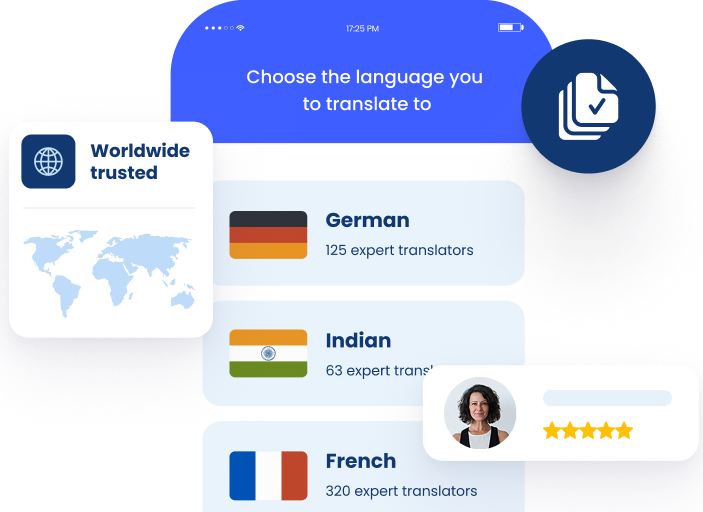
At The Language Doctors, we specialize in USCIS-certified translations that are trusted and accepted by immigration attorneys, government agencies, and embassies worldwide.
With our service, you can expect fast 24–48 hour turnaround times, certified translations in over 200 languages, and PDF delivery complete with a signed Certificate of Accuracy.
Everything you need to meet USCIS requirements with confidence. We offer affordable flat-rate pricing, so you always know what to expect with no hidden fees.
Get your USCIS translation today. Accurate, certified, and hassle-free.