Dana was captioning MSNBC on September 11, 2001.
With captioners in New York knocked offline, remote captioners across the country stepped in to cover a stretch of news so intense they went on air for three and four hours at a time with no breaks.
“I remember the first commercial break we even took was three weeks later.”
She remembers one father watching the World Trade Center cleanup, saying over and over that he would not leave until his son was found. She remembers a Christmas tree bursting into flames on a live news segment and praying the children in that home had already opened their presents.
“He has no idea that a woman in Iowa in her basement office is thinking of him. But I am. I take those things very close to my heart.”
The years of middle-of-the-night calls for tornadoes, wildfires and breaking news have given Dana a particular kind of memory – one made of words she typed under pressure, for people she will never meet.
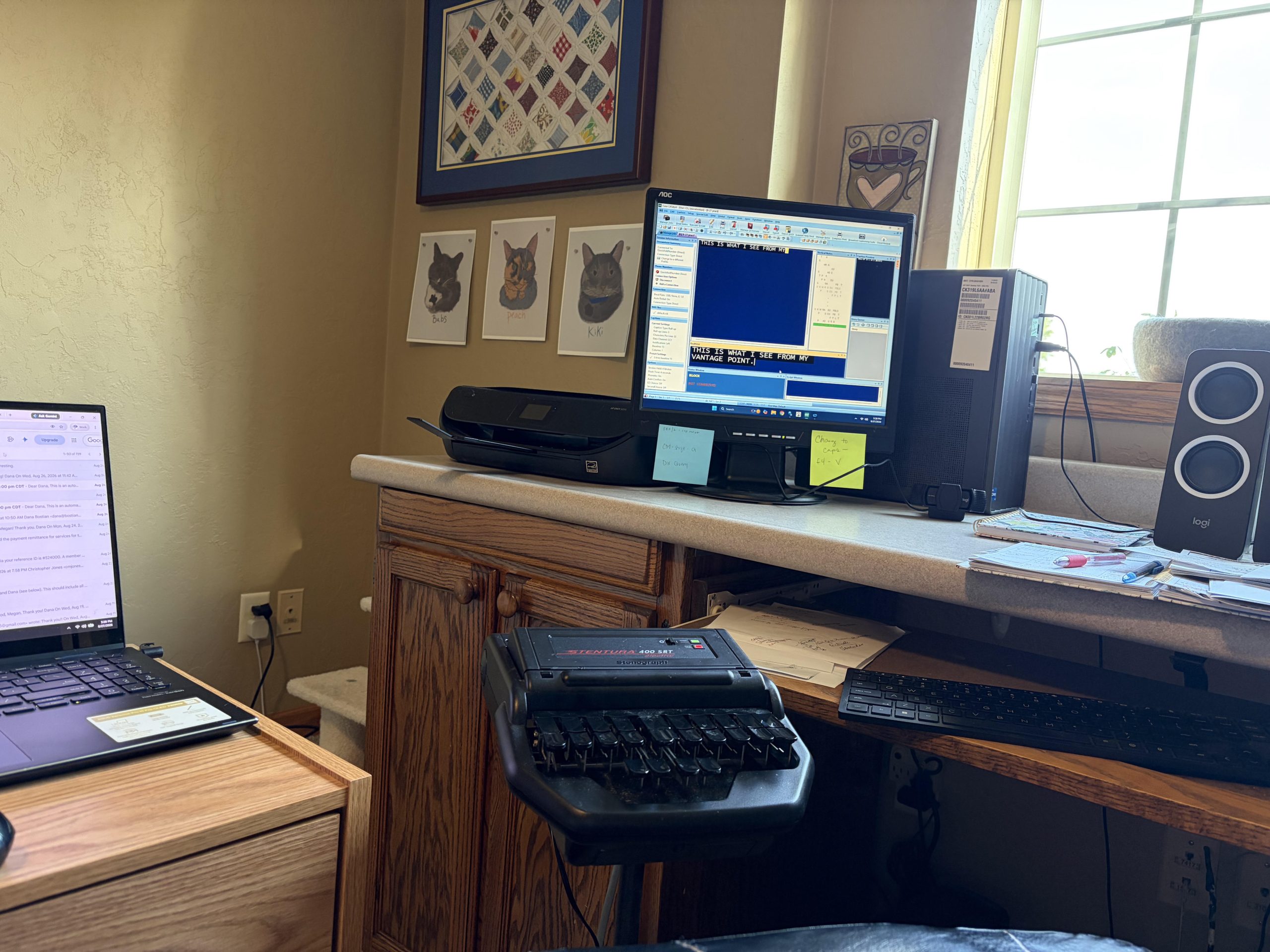
Partway through the episode, Dana walked Jose through a quick demonstration of how steno works.
Write the letter T. Underneath it, write the letter K.
Press the T with your left ring finger – that is the word “it.” Press the K with the same finger – that is the word “can.” Press both at once – that is the word “did.”
Add an asterisk to the T and it becomes a lowercase t. Add a period and it becomes a capital T. The same rules apply to the K and the combined keys.
Three words. One finger. Twelve keys that produce the entire alphabet while simultaneously forming whole words.
“That is a very small snippet of what we’re thinking as we’re captioning.”
Court Reporting vs. CART
The difference between what Dana did in the courtroom and what she does now? The answer is control.
In court, if someone speaks too fast, mumbles or talks over another person, the court reporter can stop everything and ask for a repeat. In live captioning, there is no pause button.
“My goal is always word for word, as perfectly as I can. But we are not perfect. One slip of the finger can be a totally different word.”
The goal is accuracy with grace – delivering the story to someone who is reading, not hearing, in close to real time.
Captioning Becomes Part of Your Brain
After a certain number of years, Dana says, captioning stops being something you do and becomes something you are.
She captions in her head while watching TV. She captions in her head at church. If she hears an unfamiliar word in conversation, she stops to work out how she would write it in steno.
“You can’t shut it off. It’s now part of you.”
She even plays word games on her phone and finds herself trying to type the answers in shorthand.
Compassion, Not Just Precision
When we asked Dana to describe her work in one word, he offered “empathy.” Dana gently replaced it.
“The word I would use is compassion.”
Captioners, Dana explained, are a close-knit community for a reason. Most of them share a service-oriented instinct – a desire to be the quiet person in the background making communication possible for someone who needs it.
“We’re there for one reason, and that is for the hearing impaired.”
She mentioned airports, counseling appointments, graduations, sporting events, college classrooms. Anywhere there is a person who needs words on a screen, there is a captioner on the other end of a Zoom link or a captioning platform, typing in real time.
Advice for the Next Generation
“Social media has created so many more opportunities to connect with us. Connect with us. We know what companies are good to work for. We know which ones to pull away from. We will take you under our wing.”
It is advice that reflects Dana’s entire career – the classmate who got her into remote captioning, the colleague who handed her clients at retirement, the business partner she met through a chain of mutual connections.
The Quiet Craft Behind the Words
The next time a tornado warning scrolls across the bottom of your screen, or a professor’s lecture appears in real-time text, or an airport announcement is captioned on a departure board, there is a good chance a human is working behind it.
Possibly a woman in a basement office in Iowa, who has been doing this work for over three decades, who holds the stories she captions close to her heart, and whose job is to make sure every word arrives in the hands of the person who needs it.
As Dana puts:
“It’s more than just a push of a button. We’re here to help you. We’re here to connect you to what you need.”