


If you have ever visited Morocco, Lebanon, Egypt, or another Arabic-speaking country, you might have been confused – people speak the same language, but it sounds completely different. That is because Arabic is more like a family of dialects, each with its own personality. Let’s explore the diversity and beauty of these dialects that shape daily life across the Arab world.
A Journey Through Time: The Origins of Arabic Dialects
All Arabic dialects share the same roots in Classical Arabic, which is the language of the Quran, and its modern descendant, Modern Standard Arabic (MSA), acts as a common bridge.
When the Islamic Empire expanded in the 7th century, Arabic spread across vast territories, blending with the local languages of North Africa, the Levant, and beyond. This contact sparked the creation of regional dialects that absorbed local influences while staying connected to their classical origin.
From Empire to Everyday: The Rise of Modern Standard Arabic
Modern Standard Arabic emerged as a simplified and standardized version of Classical Arabic to meet the needs of a growing and diverse Arab population. Today, MSA is the official form of Arabic used in formal communication, education, media, and literature. It serves as the linguistic glue between Arab countries, facilitating mutual understanding despite significant dialectal differences.
One Region, Many Voices: The Main Arabic Dialect Groups
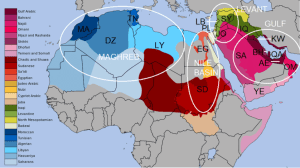
Arabic dialects are usually categorized into five major regional groups:
1. Maghrebi Arabic (Darija)
Spoken in Morocco, Algeria, Tunisia, Libya, and Mauritania, Maghrebi Arabic is heavily influenced by Berber, French, and colonial languages. Its grammar and pronunciation can feel foreign even to other Arabic speakers.
2. Egyptian Arabic (Masri)
Known for its broad reach due to Egypt’s film and music industries, Egyptian Arabic is understood by many Arabs outside Egypt. It features Coptic and Turkish influences, showcasing Egypt’s rich cultural heritage.
3. Levantine Arabic (Shami)
Spoken in Lebanon, Syria, Jordan, and Palestine, Levantine Arabic is characterized by a softer and more melodic tone. It retains traces of Aramaic and Canaanite, reflecting ancient regional influences.
4. Gulf Arabic (Khaliji)
Found in countries like Saudi Arabia, Bahrain, Kuwait, Qatar, and the UAE, Gulf Arabic is shaped by Persian trade links and Bedouin heritage. It is rhythmic and includes a range of Persian loanwords.
5. Yemeni Arabic
Often considered the closest to Classical Arabic, Yemeni Arabic retains many ancient features and distinctive sounds. Due to the country’s isolation, its dialect has stayed distinct and deeply traditional.
Not Just Words: The Differences Between Dialects
Arabic dialects differ in more than just vocabulary. They vary in grammar, sentence structure, and even the way verbs function. For instance:
- In Moroccan Arabic, past tense verbs have a unique gender-neutral ending -i (e.g., شنو قلتي؟ Shnu gelti? “What did you say?” applies to both men and women).
- Egyptian Arabic changes word order, placing adjectives and question words after the noun. “Where are you going?” becomes رايح فين؟ raayeH feen? (literally “going where?”).
- Syrian Arabic closely mirrors English in expressing tense. بتكتب B-tektob means “she writes,” while عم تكتب means “she is writing.” Future tense uses رح raH, similar to “going to” in English.
The Heartbeat of Arabic: Dialects as Culture, Identity, and Connection
Arabic dialects are powerful markers of identity, revealing a person’s origin, social background, and even education. While regional differences can create communication challenges, MSA serves as a unifying thread. Still, dialects remain at the heart of daily life, enriched by media, music, and now social platforms that foster cross-dialect exchange. Together, they form a vibrant mosaic of voices, all rooted in a shared language and culture.